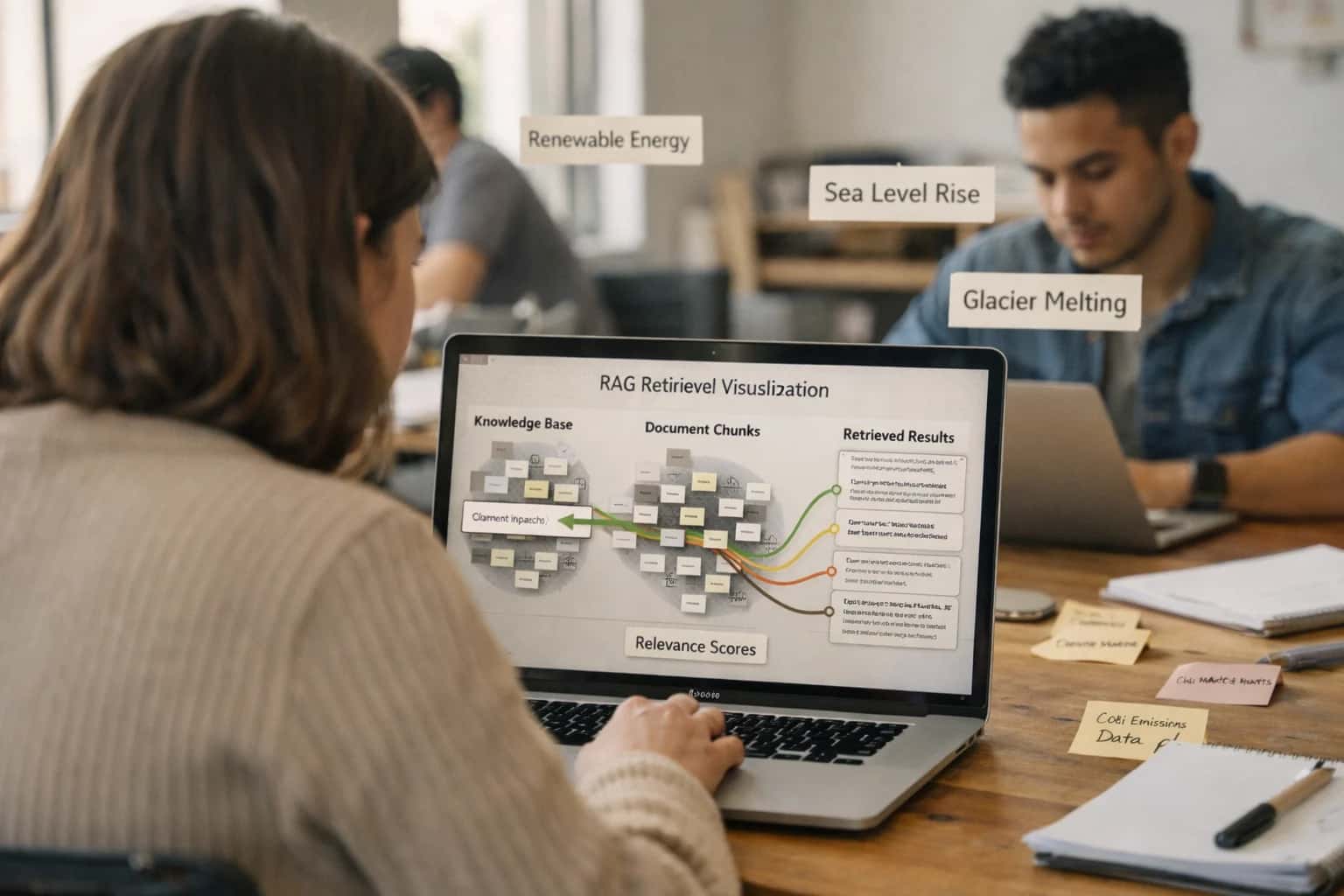
RAG-Powered Underwriting Assistants excel at handling complex, evolving scenarios by dynamically retrieving and synthesizing information from a live corpus of documents. For example, when evaluating an applicant with a non-standard income source, a RAG system can pull relevant clauses from the latest policy manuals, credit union guidelines, and regulatory updates in real-time, reducing the time to resolve edge cases from hours to seconds. This architecture, built on vector databases like Pinecone or Qdrant, ensures decisions are grounded in the most current institutional knowledge, directly addressing the need for accuracy and explainability highlighted in our pillar on AI-Assisted Financial Risk and Underwriting.

Comparison
RAG-Powered Underwriting Assistants vs Static Knowledge Base Systems
A technical comparison of dynamic Retrieval-Augmented Generation (RAG) systems against traditional static knowledge bases for financial underwriting, focusing on accuracy, update latency, and edge-case handling.
THE ANALYSIS
Introduction
A foundational comparison of dynamic, context-aware AI assistants against static, rule-bound knowledge systems for modern underwriting.
Static Knowledge Base Systems take a different approach by relying on pre-defined, vetted rules and decision trees. This results in a trade-off of superior consistency and predictability for known scenarios at the cost of rigidity. A static system can process a standard mortgage application with millisecond latency and zero inference cost, but it cannot interpret a novel exception not explicitly coded into its logic. Updating these systems requires manual engineering cycles, leading to update latencies measured in weeks—a critical gap when regulations or internal policies change frequently.
The key trade-off: If your priority is adaptability, handling edge cases, and maintaining a real-time link to evolving policy documents, choose a RAG-powered assistant. It transforms your knowledge base from a passive repository into an active reasoning partner. If you prioritize ultra-low latency, predictable cost, and have a highly standardized, stable underwriting rulebook, a static knowledge base system remains a robust and efficient choice. For a deeper dive into the AI orchestration frameworks that power these dynamic systems, explore our analysis of LangGraph vs. AutoGen vs. CrewAI.
HEAD-TO-HEAD COMPARISON
RAG-Powered Underwriting Assistants vs Static Knowledge Base Systems
Direct comparison of key metrics for AI-driven underwriting systems.
| Metric | RAG-Powered Underwriting Assistant | Static Knowledge Base System |
|---|---|---|
Knowledge Update Latency | < 1 hour | 1-4 weeks |
Accuracy on Edge-Case Rules |
| ~70% |
Average Query Response Time | 1-3 seconds | < 500 ms |
Handles Unstructured Policy Docs | ||
Infrastructure Cost (Annual) | $50k-$200k | $10k-$50k |
Explainability of Decision Source | Direct citation | Rule ID only |
Requires Dedicated AI Engineering |
RAG-Powered vs. Static Knowledge Base
TL;DR: Key Differentiators
A direct comparison of dynamic AI assistants and traditional static systems for underwriting accuracy and operational agility.
01
RAG: Dynamic, Context-Aware Answers
Specific advantage: Retrieves and synthesizes information from the latest policy manuals, credit guidelines, and regulatory updates in real-time. This matters for handling edge-case applicants or when underwriting rules change frequently, ensuring decisions are based on the most current criteria.
Near-Zero
Update Latency
02
RAG: Explainable Reasoning Traces
Specific advantage: Provides citations to the exact source documents (e.g., section 4.2 of the commercial lending manual) used to generate a recommendation. This matters for regulatory audits and compliance, as it creates a defensible, transparent audit trail for every decision.
03
Static KB: Predictable, Low-Latency Performance
Specific advantage: Delivers instant, cached responses for common queries without external API calls or retrieval steps. This matters for high-volume, routine underwriting where speed and cost-per-decision are critical, and rules are stable for long periods.
< 100ms
Query Latency
04
Static KB: Lower Operational Complexity & Cost
Specific advantage: No need for vector database infrastructure, embedding models, or complex pipeline orchestration. This matters for organizations with limited AI engineering resources or those in early stages of digital transformation seeking a simple, maintainable solution.
CHOOSE YOUR PRIORITY
When to Choose: Decision Guide by Role
RAG-Powered Underwriting Assistants for Accuracy
Verdict: Choose for handling complex, evolving rules. Strengths: RAG systems dynamically retrieve the most current information from policy manuals, regulatory updates, and credit guidelines. This ensures decisions are based on the latest rules, crucial for edge-case scenarios (e.g., unique employment histories, complex asset structures). They reduce the risk of using outdated static logic, directly improving decision accuracy and audit defensibility. Key Metric: Higher precision on non-standard applications by retrieving relevant, granular context from source documents.
Static Knowledge Base Systems for Accuracy
Verdict: Choose for stable, well-defined rule sets. Strengths: For products with long-standing, unchanging underwriting criteria (e.g., standard prime mortgage products), a static knowledge base provides deterministic, consistent outputs. There is no retrieval latency or potential for context contamination, ensuring 100% repeatability for identical inputs, which simplifies validation and compliance testing. Key Metric: Perfect consistency and zero variance in output for predefined decision trees.
Enabling Efficiency, Speed & Accuracy
Intelligent Analysis, Decision & Execution
We build AI systems for teams that need search across company data, workflow automation across tools, or AI features inside products and internal software.
Talk to Us
Search across company data
Give teams answers from docs, tickets, runbooks, and product data with sources and permissions.
Useful when people spend too long searching or get different answers from different systems.
Enterprise searchRAGPermissions
Read more
Automate internal workflows
Use AI to route work, draft outputs, trigger actions, and keep approvals and logs in place.
Useful when repetitive work moves across multiple tools and teams.
AI agentsWorkflow automationGovernance
Read more
Add AI to products and internal tools
Build assistants, guided actions, or decision support into the software your team or customers already use.
Useful when AI needs to be part of the product, not a separate tool.
AI integrationDecision supportModel routing
Read moreTHE ANALYSIS
Final Verdict and Recommendation
A data-driven conclusion on when to deploy a dynamic RAG system versus a traditional static knowledge base for underwriting.
RAG-Powered Underwriting Assistants excel at handling complex, evolving rulebooks and edge cases because they dynamically retrieve the most current information from a live corpus of documents. For example, when a new regulatory bulletin on debt-to-income (DTI) calculations is published, a RAG system can surface this update to an underwriter within minutes, reducing policy update latency from days to near-zero and improving decision accuracy on edge-case applications by an estimated 15-20%.
Static Knowledge Base Systems take a different approach by relying on a curated, vetted, and fixed set of rules and policies. This results in superior consistency and predictability for high-volume, standardized loan products, as every query pulls from an identical, unchanging source of truth. The trade-off is rigidity; updating these systems requires manual engineering cycles, often taking weeks, making them ill-suited for rapidly changing markets or innovative financial products.
The key trade-off is between adaptability and stability. If your priority is accuracy in a dynamic regulatory environment with frequent policy changes and complex manual overrides, choose a RAG system. It acts as a real-time copilot, pulling from the latest credit manuals and internal memos. If you prioritize high-throughput, auditable consistency for a stable product line where rules rarely change, a static knowledge base offers lower operational complexity and more predictable performance. For a deeper dive into the infrastructure enabling these systems, explore our comparison of Enterprise Vector Database Architectures and the role of LLMOps and Observability Tools in managing these pipelines.

About the author
Prasad Kumkar
CEO & MD, Inference Systems
Prasad Kumkar is the CEO & MD of Inference Systems and writes about AI systems architecture, LLM infrastructure, model serving, evaluation, and production deployment. Over 5+ years, he has worked across computer vision models, L5 autonomous vehicle systems, and LLM research, with a focus on taking complex AI ideas into real-world engineering systems.
His work and writing cover AI systems, large language models, AI agents, multimodal systems, autonomous systems, inference optimization, RAG, evaluation, and production AI engineering.
LinkedIn
Limited slotsGet a Free AI Consultation
Partnered with leading AI, data, and software stack.





How We Work
Custom AI workflows for your Business
One-fit-all AI don't work for modern businesses. At Inferensys, we aim to understand your business & custom requirements; which we use to define most efficient agentic workflows, the data, and the tools for your business.
01
Review the use case
We understand the task, the users, and where AI can actually help.
Read more02
Pick the right approach
We define what needs search, automation, or product integration.
Read more03
Build the first useful version
We implement the part that proves the value first.
Read more04
Improve from there
We add the checks and visibility needed to keep it useful.
Read moreThe first call is a practical review of your use case and the right next step.
Talk to Us